DR Congo Colonel Kibibi Mutware Jailed for Mass Rape
taken from BBC NEWS
A military court in eastern Democratic Republic of Congo investigating a case of mass rape has sentenced Lt Col Kibibi Mutware to 20 years in jail.
He was found guilty of crimes against humanity for sending his troops to rape, beat up and loot from the population of Fizi on New Year's Day.
Forty-nine women came to testify in the court in in Baraka.
The BBC's Thomas Hubert says it is the first conviction of a commanding officer for rape in eastern DR Congo.
Humanitarian agencies regularly cite government troops as the largest single group of perpetrators of widespread sexual violence in the Kivu region, says our reporter, who is in the town of Baraka, not far from Fizi.
Anger
Sitting in a mobile open air court in Baraka, the military judges also sentenced three officers serving under Lt Col Mutware to 20 years and five soldiers to between 10 and 15 years.
Our reporter says some of the estimated 2,000 people who attended the verdict proceedings, reacted angrily to the sentences.
A victim of the mass rape in Fizi on New Year's day, who testified in court, and her child This woman is one of the 49 rape victims who gave evidence
Crowds surrounded the vehicles which took away the soldiers and began shouting.
"The people are not happy with this judgement; the people were expecting the death sentence," one man in the crowd told the BBC.
Lt Col Mutware is one of many former rebels who joined the army as part of peace agreements in 2009.
The judges said the state should pay compensation to the more than 60 women were raped on 1 January in Fizi.
Our reporter says it is unusual for such large numbers of victims in eastern DR Congo to be willing to testify against their rapists.
Ahead of the verdict, many of them gathered at the rape victims' centre in Fizi.
"I was fleeing the violence but unfortunately I met four soldiers," a 29-year-old mother of five told the BBC about the events on New Year's day.
"They began to tear the pants I was wearing. They took my child from my arms and left him on the ground. Then they had sex with me."
In August 2010, rebel forces were accused of raping hundreds of women, girls, men and boys around the town of Luvungi.
Map
The UN recorded some 11,000 rapes in 2010 - the true figure is believed to be much higher.
Our reporter says since January there have been other reports of sexual violence in an area where the Rwandan FDLR rebels are still active, 40km (about 25 miles) from Fizi.
Medical charity Medecins Sans Frontieres says it is planning to deploy a mobile clinic to the area on Monday after receiving credible reports of 30 new rapes last week.
It says it has treated more than 70 victims of rapes in two similar incidents in the area between 19 January and 4 February.
Wednesday, February 23, 2011

Monday, February 7, 2011
Wednesday, February 2, 2011
Moise Katumbi: Football team owner determined to rebuild Congo
Moise Katumbi: Football team owner determined to rebuild Congo
From Tom Hayes, CNN
"I can't live without my soccer team," says Katumbi. If he had to choose between the governorship and being chairman of the team, "I think I'll go to my team," he says.
A self-made businessman, Katumbi worked his way up from selling fish as a teenager from the back of his brother's truck to becoming one of the DRC's most successful entrepreneurs.
His business acumen led to calls for him in 2007 to enter politics. That's something Katumbi says initially he was reluctant to do.
"After a lot of talking on the end they convinced me to try," he said. "I promised the president, if I'm not doing well I'm going to resign because I don't know politics."
Four years later, his success in regulating Katanga's previously chaotic natural mineral extraction, coupled with his efforts to accelerate the area's rebuilding process, have made him an increasingly important figure in a country still facing massive problems after years of conflict.
Determined to make a difference as a governor, Katumbi has launched a school improvement program to make sure all of the province's children have access to a decent education.
He estimates that presently only 30% of Katanga's children go to school. His goal is to take that figure as close to 100% as possible by 2015.
"Education is even more important than mining," Katumbi says. "If you don't have minerals at least the children will be educated. They are going to run this country properly because the future is these children."
But it's not just the education infrastructure that Katumbi wants to improve -- the governor's priorities include an ambitious road building program.
"There were no roads before -- you had to choose which roads to go on with journalists," he says. "Today you can go on any road. We have more than 1,000 kilometers of tar road. In Katanga you need 12,000 kilometers."
Despite the progress in Katanga, Katumbi says much still needs to be done to improve living conditions in an area with vast untapped deposits of raw materials.
He describes Congo as a "geological scandal," pointing out not only the country's abundance of minerals, but also its good quality of soil and availability of water.
"The people have seen a lot of change, which really is a small change for me," he says. What he's done in the province "maybe is 7% of my expectation, not even 10%."
He says he doesn't plan to be in power much longer but he hopes his successor can continue and even outdo the work he has started.
If Katumbi does step down, he'll have more time to indulge his other great passion -- football.
He says the potential for social change that football brings is one of the elements that have inspired his devotion to the sport.
"Soccer is something very good for the kids to do...to stay out of doing bad things," Katumbi says. "I like doing social programs for the people, that's why I'm in soccer. Soccer is social. I don't like anyone to suffer."
From Tom Hayes, CNN
"I can't live without my soccer team," says Katumbi. If he had to choose between the governorship and being chairman of the team, "I think I'll go to my team," he says.
A self-made businessman, Katumbi worked his way up from selling fish as a teenager from the back of his brother's truck to becoming one of the DRC's most successful entrepreneurs.
His business acumen led to calls for him in 2007 to enter politics. That's something Katumbi says initially he was reluctant to do.
"After a lot of talking on the end they convinced me to try," he said. "I promised the president, if I'm not doing well I'm going to resign because I don't know politics."
Four years later, his success in regulating Katanga's previously chaotic natural mineral extraction, coupled with his efforts to accelerate the area's rebuilding process, have made him an increasingly important figure in a country still facing massive problems after years of conflict.
Determined to make a difference as a governor, Katumbi has launched a school improvement program to make sure all of the province's children have access to a decent education.
He estimates that presently only 30% of Katanga's children go to school. His goal is to take that figure as close to 100% as possible by 2015.
"Education is even more important than mining," Katumbi says. "If you don't have minerals at least the children will be educated. They are going to run this country properly because the future is these children."
But it's not just the education infrastructure that Katumbi wants to improve -- the governor's priorities include an ambitious road building program.
"There were no roads before -- you had to choose which roads to go on with journalists," he says. "Today you can go on any road. We have more than 1,000 kilometers of tar road. In Katanga you need 12,000 kilometers."
Despite the progress in Katanga, Katumbi says much still needs to be done to improve living conditions in an area with vast untapped deposits of raw materials.
He describes Congo as a "geological scandal," pointing out not only the country's abundance of minerals, but also its good quality of soil and availability of water.
"The people have seen a lot of change, which really is a small change for me," he says. What he's done in the province "maybe is 7% of my expectation, not even 10%."
He says he doesn't plan to be in power much longer but he hopes his successor can continue and even outdo the work he has started.
If Katumbi does step down, he'll have more time to indulge his other great passion -- football.
He says the potential for social change that football brings is one of the elements that have inspired his devotion to the sport.
"Soccer is something very good for the kids to do...to stay out of doing bad things," Katumbi says. "I like doing social programs for the people, that's why I'm in soccer. Soccer is social. I don't like anyone to suffer."
Tuesday, January 18, 2011
Remembering Lumumba

NY Times: An Assassination’s Long Shadow
January 16, 2011
By ADAM HOCHSCHILD
TODAY, millions of people on another continent are observing the 50th anniversary of an event few Americans remember, the assassination of Patrice Lumumba. A slight, goateed man with black, half-framed glasses, the 35-year-old Lumumba was the first democratically chosen leader of the vast country, nearly as large as the United States east of the Mississippi, now known as the Democratic Republic of Congo.
This treasure house of natural resources had been a colony of Belgium, which for decades had made no plans for independence. But after clashes with Congolese nationalists, the Belgians hastily arranged the first national election in 1960, and in June of that year King Baudouin arrived to formally give the territory its freedom.
“It is now up to you, gentlemen,” he arrogantly told Congolese dignitaries, “to show that you are worthy of our confidence.”
The Belgians, and their European and American fellow investors, expected to continue collecting profits from Congo’s factories, plantations and lucrative mines, which produced diamonds, gold, uranium, copper and more. But they had not planned on Lumumba.
A dramatic, angry speech he gave in reply to Baudouin brought Congolese legislators to their feet cheering, left the king startled and frowning and caught the world’s attention. Lumumba spoke forcefully of the violence and humiliations of colonialism, from the ruthless theft of African land to the way that French-speaking colonists talked to Africans as adults do to children, using the familiar “tu” instead of the formal “vous.” Political independence was not enough, he said; Africans had to also benefit from the great wealth in their soil.
With no experience of self-rule and an empty treasury, his huge country was soon in turmoil. After failing to get aid from the United States, Lumumba declared he would turn to the Soviet Union. Thousands of Belgian officials who lingered on did their best to sabotage things: their code word for Lumumba in military radio transmissions was “Satan.” Shortly after he took office as prime minister, the C.I.A., with White House approval, ordered his assassination and dispatched an undercover agent with poison.
The would-be poisoners could not get close enough to Lumumba to do the job, so instead the United States and Belgium covertly funneled cash and aid to rival politicians who seized power and arrested the prime minister. Fearful of revolt by Lumumba’s supporters if he died in their hands, the new Congolese leaders ordered him flown to the copper-rich Katanga region in the country’s south, whose secession Belgium had just helped orchestrate. There, on Jan. 17, 1961, after being beaten and tortured, he was shot. It was a chilling moment that set off street demonstrations in many countries.
As a college student traveling through Africa on summer break, I was in Léopoldville (today’s Kinshasa), Congo’s capital, for a few days some six months after Lumumba’s murder. There was an air of tension and gloom in the city, jeeps full of soldiers were on patrol, and the streets quickly emptied at night. Above all, I remember the triumphant, macho satisfaction with which two young American Embassy officials — much later identified as C.I.A. men — talked with me over drinks about the death of someone they regarded not as an elected leader but as an upstart enemy of the United States.
Some weeks before his death, Lumumba had briefly escaped from house arrest and, with a small group of supporters, tried to flee to the eastern Congo, where a counter-government of his sympathizers had formed. The travelers had to traverse the Sankuru River, after which friendly territory began. Lumumba and several companions crossed the river in a dugout canoe to commandeer a ferry to go back and fetch the rest of the group, including his wife and son.
But by the time they returned to the other bank, government troops pursuing them had arrived. According to one survivor, Lumumba’s famous eloquence almost persuaded the soldiers to let them go. Events like this are often burnished in retrospect, but however the encounter happened, Lumumba seems to have risked his life to try to rescue the others, and the episode has found its way into film and fiction.
His legend has only become deeper because there is painful newsreel footage of him in captivity, soon after this moment, bound tightly with rope and trying to retain his dignity while being roughed up by his guards.
Patrice Lumumba had only a few short months in office and we have no way of knowing what would have happened had he lived. Would he have stuck to his ideals or, like too many African independence leaders, abandoned them for the temptations of wealth and power? In any event, leading his nation to the full economic autonomy he dreamed of would have been an almost impossible task. The Western governments and corporations arrayed against him were too powerful, and the resources in his control too weak: at independence his new country had fewer than three dozen university graduates among a black population of more than 15 million, and only three of some 5,000 senior positions in the civil service were filled by Congolese.
A half-century later, we should surely look back on the death of Lumumba with shame, for we helped install the men who deposed and killed him. In the scholarly journal Intelligence and National Security, Stephen R. Weissman, a former staff director of the House Subcommittee on Africa, recently pointed out that Lumumba’s violent end foreshadowed today’s American practice of “extraordinary rendition.” The Congolese politicians who planned Lumumba’s murder checked all their major moves with their Belgian and American backers, and the local C.I.A. station chief made no objection when they told him they were going to turn Lumumba over — render him, in today’s parlance — to the breakaway government of Katanga, which, everyone knew, could be counted on to kill him.
Still more fateful was what was to come. Four years later, one of Lumumba’s captors, an army officer named Joseph Mobutu, again with enthusiastic American support, staged a coup and began a disastrous, 32-year dictatorship. Just as geopolitics and a thirst for oil have today brought us unsavory allies like Saudi Arabia, so the cold war and a similar lust for natural resources did then. Mobutu was showered with more than $1 billion in American aid and enthusiastically welcomed to the White House by a succession of presidents; George H. W. Bush called him “one of our most valued friends.”
This valued friend bled his country dry, amassed a fortune estimated at $4 billion, jetted the world by rented Concorde and bought himself an array of grand villas in Europe and multiple palaces and a yacht at home. He let public services shrivel to nothing and roads and railways be swallowed by the rain forest. By 1997, when he was overthrown and died, his country was in a state of wreckage from which it has not yet recovered.
Since that time the fatal combination of enormous natural riches and the dysfunctional government Mobutu left has ignited a long, multisided war that has killed huge numbers of Congolese or forced them from their homes. Many factors cause a war, of course, especially one as bewilderingly complex as this one. But when visiting eastern Congo some months ago, I could not help but think that one thread leading to the human suffering I saw begins with the assassination of Lumumba.
We will never know the full death toll of the current conflict, but many believe it to be in the millions. Some of that blood is on our hands. Both ordering the murders of apparent enemies and then embracing their enemies as “valued friends” come with profound, long-term consequences — a lesson worth pondering on this anniversary.
***Adam Hochschild is the author of “King Leopold’s Ghost: A Story of Greed, Terror and Heroism in Colonial Africa” and the forthcoming “To End All Wars: A Story of Loyalty and Rebellion, 1914-1918.”
Wednesday, December 15, 2010
TP Mazembe triumph
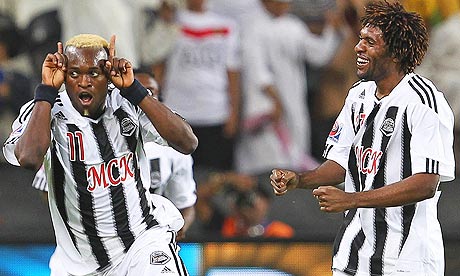
TP Mazembe stun Internacional for historic win
Tue Dec 14, 2:25 pm ET
ABU DHABI (AFP) – African champions Tout Puissant Mazembe pulled off the biggest shock in the 10-year history of the Club World Cup by beating Internacional 2-0 in the semi-finals here on Tuesday.
The side from the Democratic Republic of Congo prevailed through fine second-half strikes by Mulota Kabangu and Dioko Kaluyituka to become the first team from outside Europe and South America to reach the tournament's final.
Having already seen off Mexicans Pachuca in the quarter-finals, they will now face either European champions Inter Milan or Asian Champions League holders Seongnam Ilhwa of South Korea in Sunday's decider. "We believed in ourselves, we were confident and you could see that when we started attacking, especially at the start of the second half," said TP Mazembe coach Lamine N'Diaye.
"We were lucky too, and don't forget that our goalkeeper was excellent -- he was like a magician! But to win 2-0, it?s a day of happiness for us. "It's very good for this team and for the Congolese people, and every African should be proud of this team."
South American champions Internacional, from the Brazilian city of Porto Alegre, were bidding to become the first team to win the competition twice, having already tasted success in 2006.
They were, however, routinely frustrated by TP Mazembe goalkeeper Muteba Kidiaba, whose brilliance played a decisive role in one of the most famous results in his club's history. "We had lots of great opportunities but unfortunately their goalkeeper was excellent," said Internacional coach Celso Roth.
"It was time for Africa to reach the final and unfortunately it has been at our expense. There's no dishonour in that -- African football is improving all the time and I don't see anything shameful in losing to an African team."
Inter's technical qualities were apparent from kick-off and their inventive approach play saw them procure a number of early opportunities. Rafael Sobis twice shot off target before being denied by a brilliant save from Kidiaba, who plunged to his left to deny the former Real Betis forward as he took aim from 10 yards. Inter defender Indio went close with a header that flashed across the face of goal, while precise crosses from right-back Nei set up first Tinga and then Matias, neither of whom were able to find the target.
The second half was eight minutes old when Kabangu made the breakthrough, skilfully taming the ball inside the Inter box and then steering a half-volley inside the right-hand post with his right instep.
Sobis spurned two chances to equalise for Inter, drawing a smart reaction save from Kidiaba with a swerving strike and then heading over from Andres D'Alessandro's left-wing centre.
Roth made two changes in a bid to force a way back into the contest and saw substitute Giuliano bring another splendid stop from Kidiaba with a left-foot effort in the 69th minute.
As the Brazilians pressed forward, TP Mazembe hit them with a sucker punch in the 85th minute.
Kaluyituka picked up the ball wide on the left and bamboozled Pablo Guinazu with a series of step-overs before cracking a low drive into the bottom-left corner from the edge of the box.
Friday, December 3, 2010
Monday, November 22, 2010
Former DR Congo leader faces trial
Jean-Pierre Bemba pleads not guilty to charges of murder and rape as his war crimes trial begins at The Hague.
Jean-Pierre Bemba, former vice-president of the Democratic Republic of Congo, has gone on trial for rape and murder allegedly committed by his troops in the neighbouring Central African Republic (CAR).
The 48 year old pleaded not guilty as the trial began at the International Criminal Court (ICC) in The Hague on Monday afternoon.
Bemba is charged with three counts of war crimes and two counts of crimes against humanity for the alleged atrocities by about 1,500 fighters of his Congolese Liberation Movement (MLC) between October 2002 and March 2003.
He is the most senior political leader to be detained so far by the ICC.
"It is the first time in the history of international justice that a military commander is on trial on the basis of indirect criminal responsibility for rapes committed by his fighters," an official in the prosecutor's office told the AFP news agency.
The case, which is expected to continue for months, should serve as an "example" for others who lead fighters in war, he said.
'Unfair trial'
Jonah Hull, Al Jazeera's correspondent in The Hague, said the defence team told a pre-trial news conference that the court was likely to see "the most unfair trial in the history of international justice".
"[The defence] said that Bemba in essence had no command of his forces once they crossed the border into the Central African Republic and that ultimate responsibility lies with Ange-Felix Patasse, the then-president of the CAR, who invited Bemba's forces in to put down a coup in the first place."
But Luis Moreno-Ocampo, chief prosecutor of the ICC, told the news conference that "the evidence shows that the troops were always under the authority and command and control of Jean-Pierre Bemba".
"The MLC is the army of and owned by Jean-Pierre Bemba," he said.
"Bemba created it, to make money and to make power ... and that is the point for us: you will not make money or power by committing atrocities. You will be jailed."
So far, 759 victims have been authorised to participate in the trial, with a further 500 applicants for the court to consider, a registrar said.
"It's the first time in the history of international justice that such a large group of people has been authorised to participate," Paolina Massidda of the ICC's office of public counsel for victims was quoted by AFP as saying.
Prosecutors say that about 400 rapes were recorded in Bangui, the capital of the CAR.
These were carried out during five months of fighting as the MLC helped Patasse resist a coup led by Francois Bozize, the current CAR president.
But Aime Kilolo, Bemba's defence lawyer, said that the MLC "fought in the uniform of the Central African Republic and under its flag, it was the Central African authorities who were in charge of command and discipline".
Bemba fled DR Congo in 2007, after coming second to Joseph Kabila in a presidential election and subsequently refusing to disband his armed group. The decision led to clashes that left hundreds dead.
The former vice-president was arrested in Brussels in May 2008 on an ICC warrant. The court was asked to take the case by Bozize.
Source:
Al Jazeera and agencies
Jean-Pierre Bemba, former vice-president of the Democratic Republic of Congo, has gone on trial for rape and murder allegedly committed by his troops in the neighbouring Central African Republic (CAR).
The 48 year old pleaded not guilty as the trial began at the International Criminal Court (ICC) in The Hague on Monday afternoon.
Bemba is charged with three counts of war crimes and two counts of crimes against humanity for the alleged atrocities by about 1,500 fighters of his Congolese Liberation Movement (MLC) between October 2002 and March 2003.
He is the most senior political leader to be detained so far by the ICC.
"It is the first time in the history of international justice that a military commander is on trial on the basis of indirect criminal responsibility for rapes committed by his fighters," an official in the prosecutor's office told the AFP news agency.
The case, which is expected to continue for months, should serve as an "example" for others who lead fighters in war, he said.
'Unfair trial'
Jonah Hull, Al Jazeera's correspondent in The Hague, said the defence team told a pre-trial news conference that the court was likely to see "the most unfair trial in the history of international justice".
"[The defence] said that Bemba in essence had no command of his forces once they crossed the border into the Central African Republic and that ultimate responsibility lies with Ange-Felix Patasse, the then-president of the CAR, who invited Bemba's forces in to put down a coup in the first place."
But Luis Moreno-Ocampo, chief prosecutor of the ICC, told the news conference that "the evidence shows that the troops were always under the authority and command and control of Jean-Pierre Bemba".
"The MLC is the army of and owned by Jean-Pierre Bemba," he said.
"Bemba created it, to make money and to make power ... and that is the point for us: you will not make money or power by committing atrocities. You will be jailed."
So far, 759 victims have been authorised to participate in the trial, with a further 500 applicants for the court to consider, a registrar said.
"It's the first time in the history of international justice that such a large group of people has been authorised to participate," Paolina Massidda of the ICC's office of public counsel for victims was quoted by AFP as saying.
Prosecutors say that about 400 rapes were recorded in Bangui, the capital of the CAR.
These were carried out during five months of fighting as the MLC helped Patasse resist a coup led by Francois Bozize, the current CAR president.
But Aime Kilolo, Bemba's defence lawyer, said that the MLC "fought in the uniform of the Central African Republic and under its flag, it was the Central African authorities who were in charge of command and discipline".
Bemba fled DR Congo in 2007, after coming second to Joseph Kabila in a presidential election and subsequently refusing to disband his armed group. The decision led to clashes that left hundreds dead.
The former vice-president was arrested in Brussels in May 2008 on an ICC warrant. The court was asked to take the case by Bozize.
Source:
Al Jazeera and agencies
Subscribe to:
Posts (Atom)


